Following municipal fire suppression, structural timbers and engineered trusses frequently lose 50 percent or more of their cross-sectional load capacity through deep charring, while thousands of gallons of…
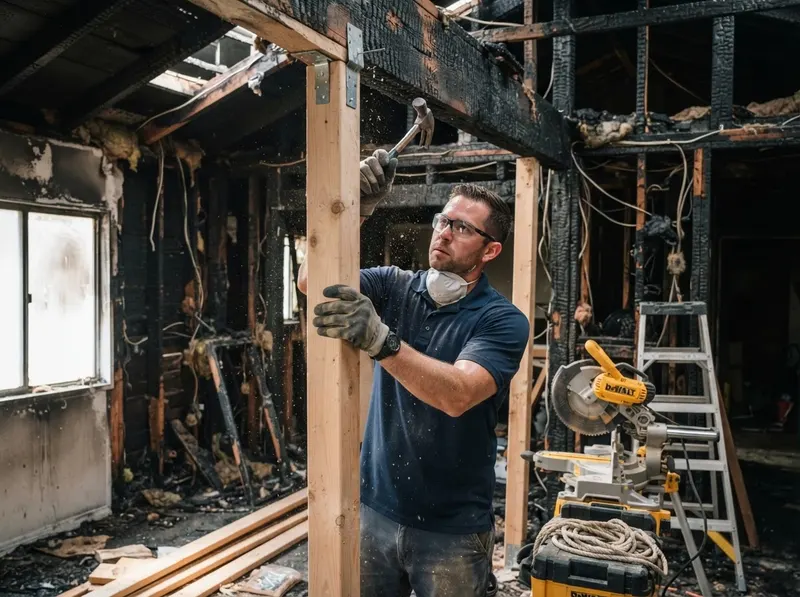
Following municipal fire suppression, structural timbers and engineered trusses frequently lose 50 percent or more of their cross-sectional load capacity through deep charring, while thousands of gallons of firefighting water add thousands of pounds of deadweight load to attic spaces and subfloors. In steep hillside environments such as the Hollywood Hills, Pacific Palisades, and Silver Lake, structural compromise is compounded by subterranean slope movement, requiring immediate engineered stabilization. Mechanical screw jacks, solid wood cribbing, and heavy-duty 4x4 or 6x6 post-and-beam assemblies are installed to support second-story decks, unreinforced masonry, and sagging roof planes before any interior assessment begins. Controlled demolition selectively removes brittle gypsum, sagging rafters, and unstable drywall partitions without disturbing intact structural envelopes, maintaining compliance with Los Angeles Department of Building and Safety (LADBS) mitigation rules.
Surgical demolition prevents collateral impact to surviving building systems, separating irreparably burned structural members from salvageable architectural elements in historic Echo Park bungalows, Boyle Heights multi-family properties, and modern Brentwood estates. When load-bearing wood framing retains structural integrity but exhibits surface charring, restoration technicians deploy non-destructive containment and media blasting rather than bulk tear-out, saving framing while eliminating deep-set carbon residues. When roof trusses collapse inward over Encino and Sherman Oaks slab foundations, controlled demolition teams utilize precision reciprocal and circular cutting methods rather than heavy hydraulic excavators to protect concrete foundations and municipal utility connections. This procedural precision confines toxic synthetic soot deposits and prevents airborne cross-contamination throughout unaffected wings of the property.
Immediate stabilization adheres strictly to California insurance documentation protocols, preventing structural collapse that would otherwise nullify or complicate coverage assessments. Structural framing technicians photograph every compromised load path, measure char depth against ASTM standards, and log moisture readings before and after temporary stabilization jacks are locked into place. In high-wind corridors near Woodland Hills and Los Feliz, unbraced perimeter walls face lateral failure from gust forces; lateral raker shores are installed directly against exterior walls to redistribute wind loads into solid ground anchors. Direct billings and scope inventories are mapped to industry-standard insurance pricing guidelines, allowing restoration engineers and licensed adjusters to review real-time photographic logs without delaying site safety approvals.
Every job gets a firm, written price after a free on-site visit.
Tell us about your structural shoring and controlled demolition job in los angeles and we'll send a clear, written quote, usually the same day.
 Elite Fire Damage Restoration