Property owners facing the sudden destruction of a residential or commercial blaze require an immediate, methodical recovery system to avert catastrophic structural failure, corrosive surface loss, and hazardous toxic off-gassing. Securing professional fire damage restoration in los angeles arrests rapid secondary oxidation on copper piping and structural steel, removes pressurized firefighting water pools before mold blooms colonize subflooring, and safely encloses breached roofs and wall envelopes against the elements.
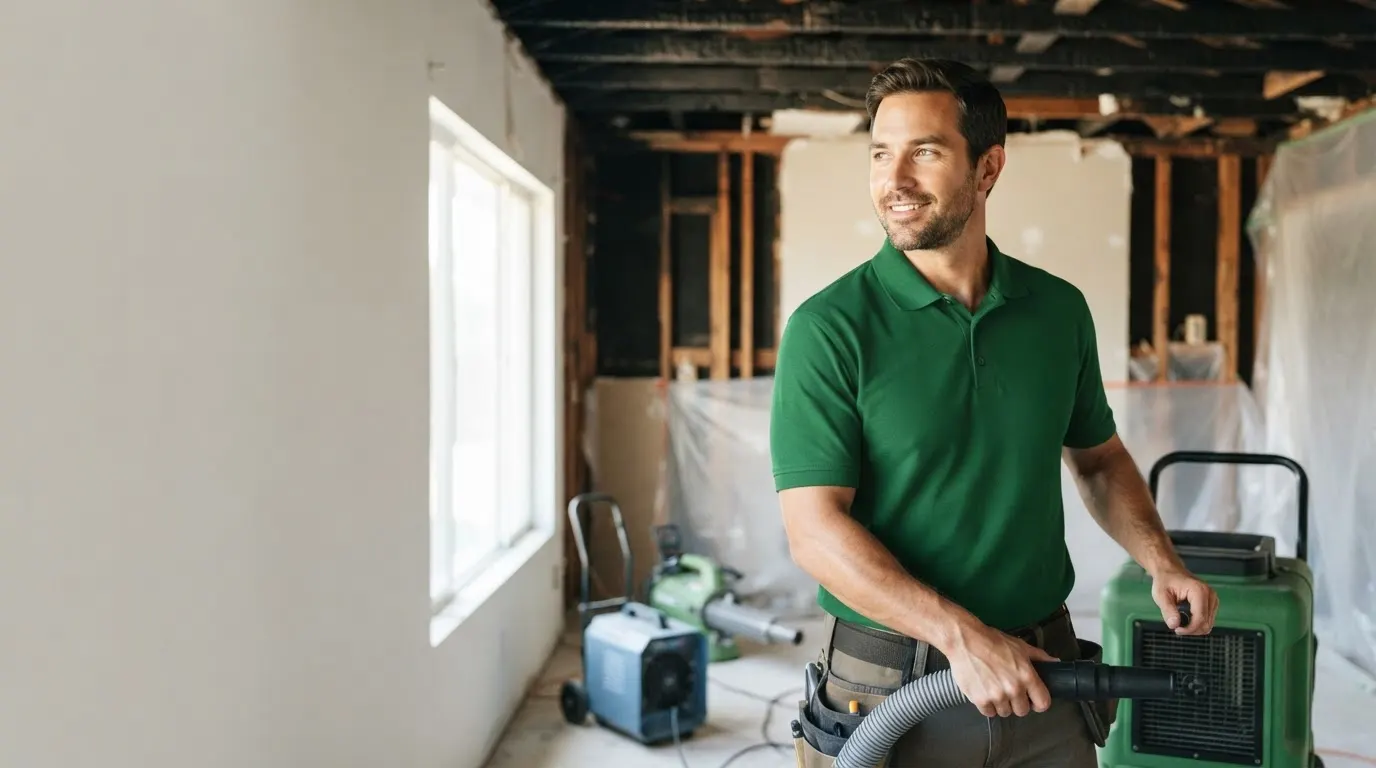
Fire damage restoration in los angeles is an engineered structural and environmental remediation process that stabilizes compromised load-bearing framing, extracts thousands of gallons of municipal suppression water, neutralizes corrosive polycyclic aromatic hydrocarbons and settled soot particulates, purges deep-seated smoke odors using thermal encapsulation, and safely rebuilds burned architectural assemblies across residential and commercial properties throughout Los Angeles County.
Every service reflects the same meticulous attention to detail, whether it's a single job or a larger fire damage restoration project across los angeles.
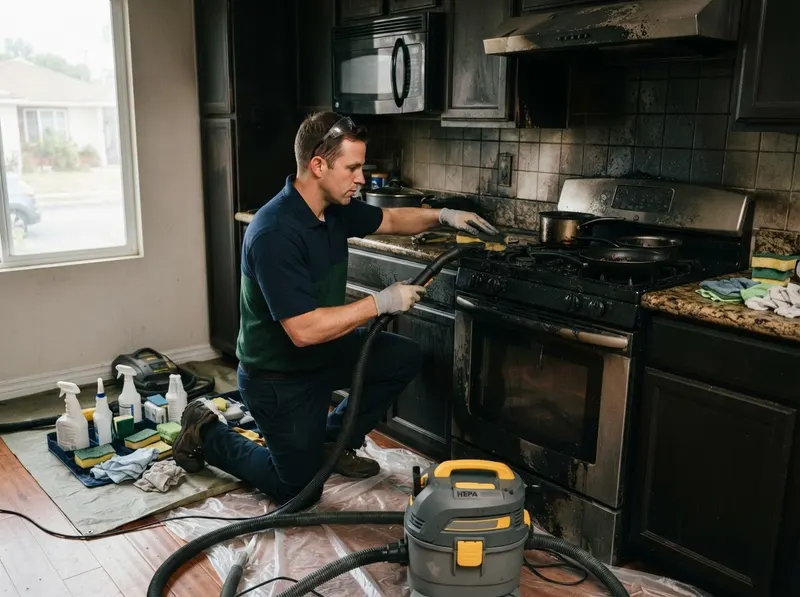
Grease and cooking oil blazes generate high-temperature protein residues that volatilize into a thin, nearly invisible, yet exceptionally sticky amber film covering vertical surfaces, upper cabinetry, exhaust ducts, and ceiling plaster. Standard household cleaners fail to dislodge protein deposits and instead cause them to smear across surfaces, locking in a rancid food-oil smell that re-emerges during warm weather. Technicians apply concentrated alkaline enzymatic solutions and emulsifying cleaners to dissolve protein bonds on finished wood, enameled appliances, and quartz or stone counters. The remediation process extends inside drawer glides, behind stove ranges, and down interior range hood exhaust ducting, accompanied by fine-particle chemical sponge wiping to capture micro-droplets without dulling cabinet varnishes.
Get a quote →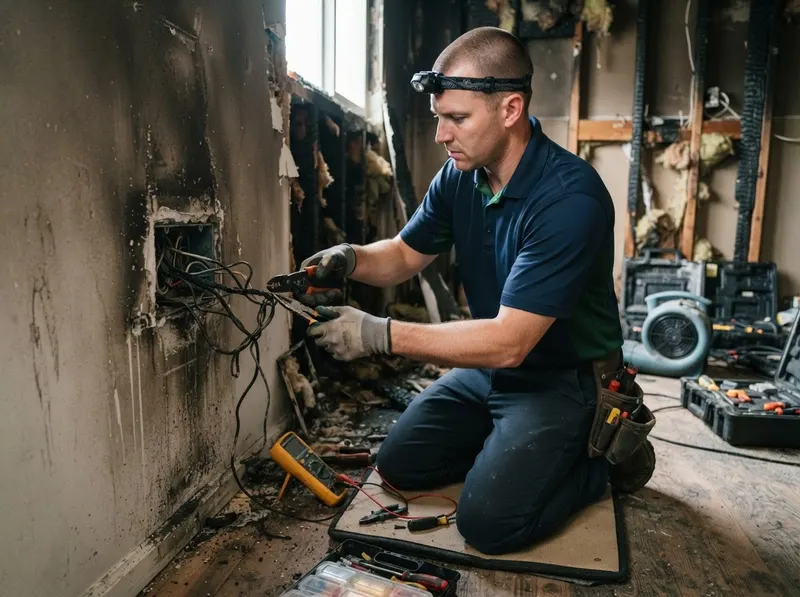
Failures originating within electrical junction boxes, overloaded service panels, or hidden conduit lines inside hollow stud cavities force corrosive plastic soot throughout the structural frame. The thermal degradation of polyvinyl chloride (PVC) wire insulation produces hydrochloric acid vapors that drift through wall cavities and settle on copper pipes, metal strapping, and outlet boxes, inducing rapid galvanic corrosion. Restoration crews locate internal burn pathways using infrared thermal scanning, strip away compromised and scorched electrical circuits, and clean out conductive carbonaceous residues that present secondary electrical arcing hazards. Stud cavities are treated with vacuum HEPA filtration and sealed with protective vapor barriers prior to electrical re-wiring.
Get a quote →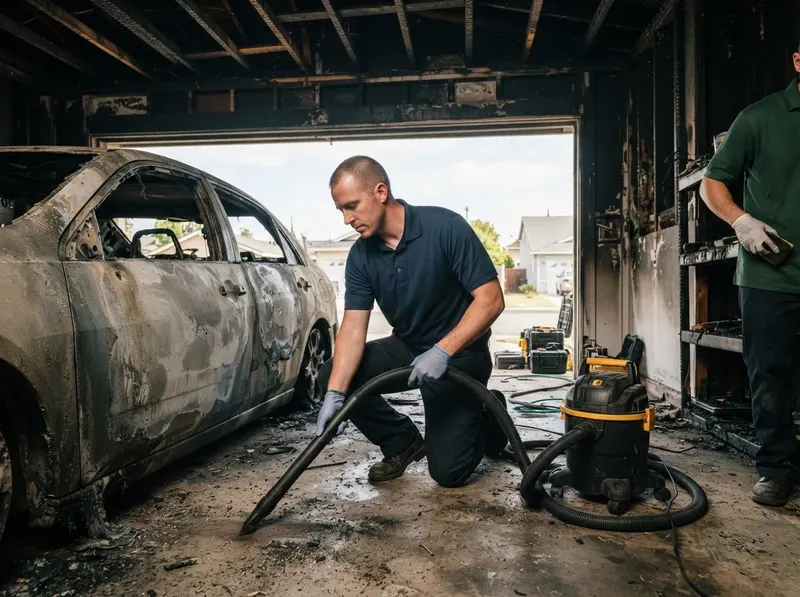
Combusting automobile tires, lithium-ion battery units, motor lubricants, brake fluids, and petroleum solvent containers release thick plumes of toxic hydrocarbon soot, heavy metals, and persistent petrochemical residues across concrete foundations. Structural clearouts require specialized personal protective equipment (PPE) and strict hazardous material containment protocols. Technicians remove charred toxic remains, utilize rotary floor scrubbers paired with industrial citrus-based solvent degreasers to pull deeply embedded motor oil and soot stains from porous concrete slabs, and wash blackened masonry walls down to the bare surface. Exposed roof rafters and wall framing receive deep mechanical dry ice blasting to remove hydrocarbon soot tags before commercial-grade primer sealers are applied.
Get a quote →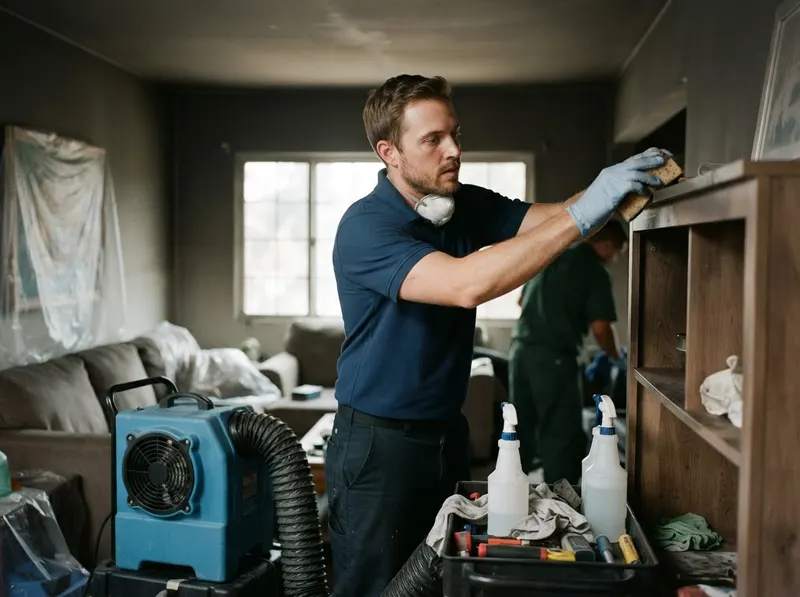
Brushfire events push dense plumes of micro-particulate wildfire smoke (PM2.5) across long distances, allowing fine ash, plant combustion particulates, and silica dust to penetrate attic vents, crawlspace breathers, and window perimeter seals. Technicians establish negative pressure zones inside the living areas to keep exterior soot from migrating inward during decontamination. The mitigation protocol includes vacuuming compromised loose-fill cellulose or fiberglass attic insulation with high-power industrial containment vacuum units, sweeping structural attic framing using dry chemical soot sponges, and applying antimicrobial surface sanitizers. Technicians then treat the complete interior volume using hydroxyl generators to eliminate natural brushfire and creosote smoke odors trapped inside upholstery, drapes, and drywall assemblies.
Get a quote →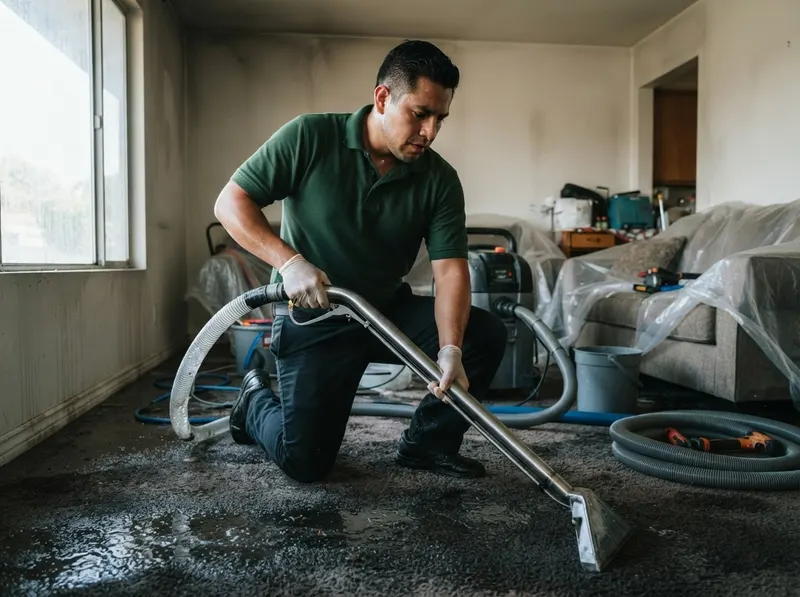
Extinguishing a residential structural fire can require anywhere from 1,000 to more than 3,000 gallons of pressurized municipal water, leaving standing water pools that seep through subflooring, saturate lower-level ceilings, and collect in crawlspaces. Technicians immediately deploy heavy-duty commercial submersible trash pumps, ride-on floor extractors, and deep-cavity extraction tools to pull standing water from the structure. Structural drying teams set up high-grain refrigerant (LGR) dehumidifiers and axial air movers in calculated cubic-foot configurations to establish continuous low-humidity vortexes. Continuous psychrometric moisture mapping tracks moisture reduction in framing lumber, plaster, and subfloors until wood moisture equivalent falls safely below 15 percent to prevent secondary microbial growth.
Get a quote →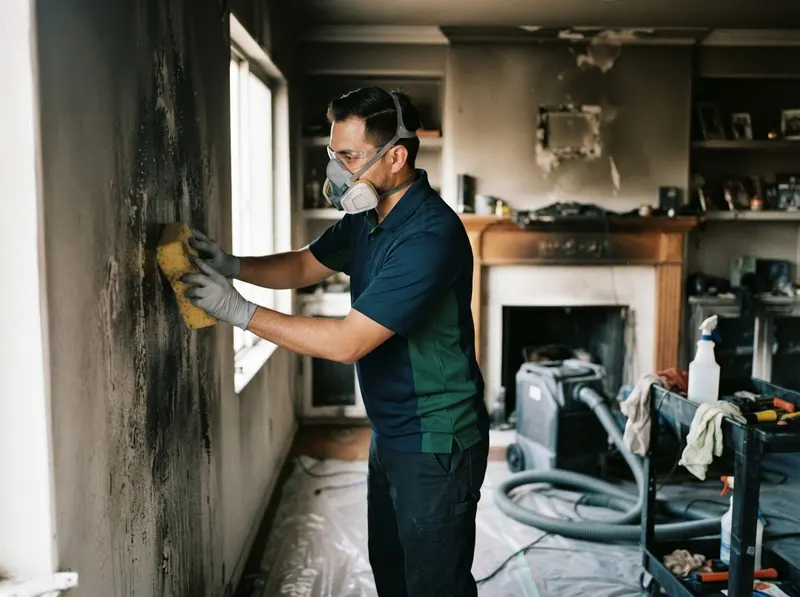
Smoke odors consist of complex volatile organic compounds, sulfur derivatives, and aromatic nitrogen rings that penetrate deeply into porous structural materials like softwood framing, sheetrock, and decorative moldings. Surface wiping alone cannot clear odor compounds from these deep microscopic voids. Restoration teams utilize a multi-tiered decontamination process starting with dry chemical sponge wiping to remove surface carbon without liquid streaking. This is followed by HEPA vacuuming along every planar edge and running industrial hydroxyl machines while the structure is occupied, or ultra-low-volume (ULV) thermal chemical fogging when the structure is vacant, which pairs deodorizing aerosols with smoke molecules to permanently neutralize malodors at the molecular level.
Get a quote →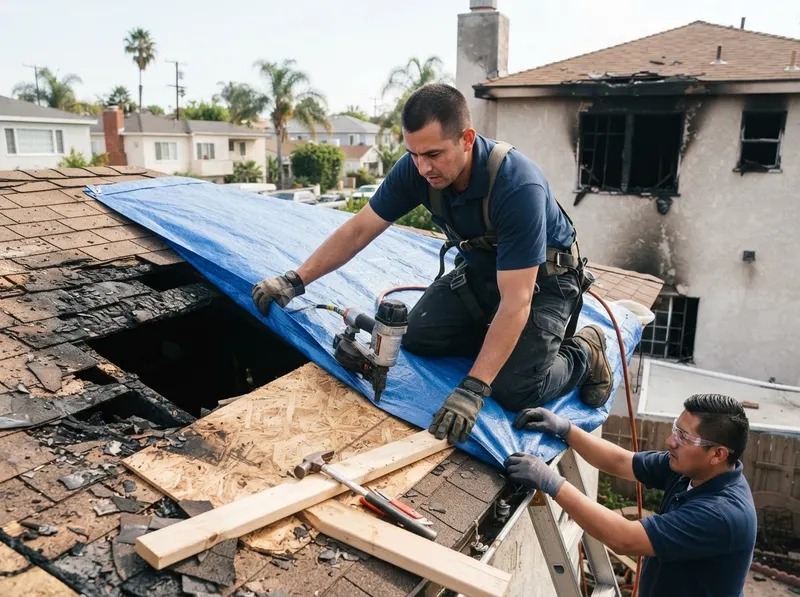
Blazes frequently shatter exterior architectural glass, warp door assemblies, and require municipal fire crews to chop mechanical ventilation holes through structural roof decking. Leaving these openings exposed invites windblown rain intrusion, environmental degradation, vandalism, and code liability. Emergency structural teams secure window and door openings with exterior-grade 1/2-inch CDX structural plywood fastened directly to framing via framing tension braces that prevent damage to intact trim work. Breached roof structures are spanned using 2x4 framing lumber support ribs and draped in heavy-gauge 10-mil woven polyethylene tarps, which are anchored securely with counter-weighted battens to resist sustained Santa Ana wind gusts.
Get a quote →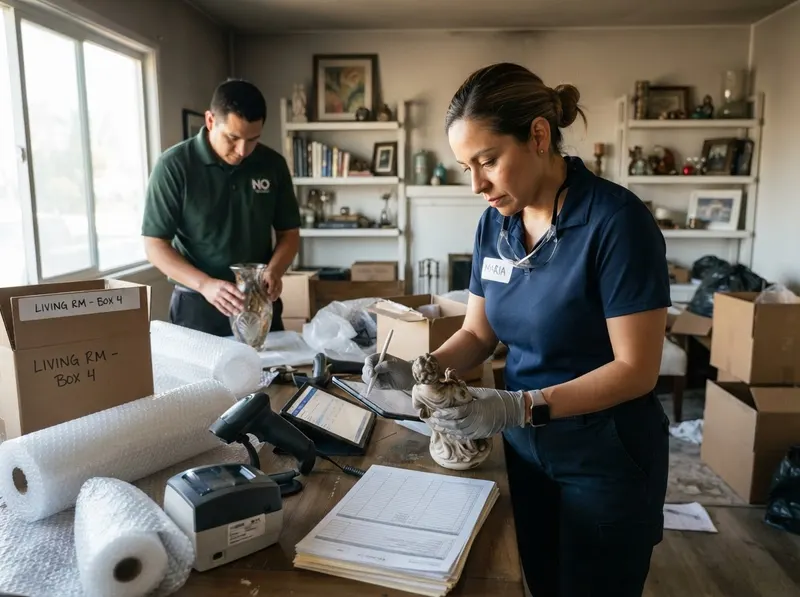
Restoring personal belongings, furniture, electronics, and valuable heirlooms demands structured on-site inventorying, careful packing, and off-site processing in a secure facility. Technicians photograph, barcode, and document each item within an asset-management database, noting pre-existing damage, char, or soot settling before loading items into protective shipping vaults. Off-site recovery combines computerized ultrasonic cleaning tanks for intricate glass and metal items, specialized dry chemical sponge stations for artwork and delicate woods, and vacuum freeze-drying chambers to salvage water-saturated paper records and family photographs. Cleaned items are stored in climate-controlled environments until structural repairs wrap up.
Get a quote →You get a firm, itemized quote for your fire damage restoration before any work begins, no surprises, no pressure.
Careful prep, tidy work, and a full cleanup when we are done. We treat your home and belongings like our own.
The same trusted, background-checked team from the first call to the final check.
Determining the precise technical scope for fire damage mitigation requires an objective, science-based evaluation of heat elevation, structural integrity, and the chemical composition of soot residues left throughout the building. When a blaze is fueled by low-heat smoldering synthetic products, such as polyurethane foam cushions, electrical insulation, vinyl floor planks, or melamine kitchen cabinetry, it yields dense, sticky, black wet smoke residues that adhere tightly to vertical wall assemblies and ceilings. If synthetic wet smoke is present, technicians must apply alkaline chemical solvents, degreasing foam compounds, and specialized dry rubber soot sponges; treating these greasy deposits with abrasive dry scrubbing or water-based sponges smears caustic petroleum tags deeper into porous sheetrock and completely destroys unsealed gypsum panels.
Conversely, when high-heat oxygen-rich fires consume natural cellulose materials, such as Douglas fir framing studs, bare subfloor lumber, or paper drywall backings at combustion temperatures exceeding 1,100 degrees Fahrenheit, the resulting dry smoke deposits fine, powdery, non-greasy carbon ash. If dry smoke coats surfaces, restoration crews deploy high-velocity HEPA vacuum extraction units, micro-abrasive dry soot capture sweeps, and clear solvent wipes; using heavy aqueous liquid washes on dry smoke causes the fine ash to dissolve and wick deep into porous wood grain, creating chronic odor bleeding that is extremely difficult to isolate later. In scenarios where municipal firefighters deploy thousands of gallons of pressurized hose water to suppress multistory or attic fires, emergency structural water extraction and low-grain refrigerant dehumidification must be executed before drywall tear-outs or blown fiberglass insulation removal begin, because moisture levels exceeding 20 percent wood moisture equivalent will trigger rapid Aspergillus and Stachybotrys mold colonization in dark wall bays inside 48 hours.
The operational trade-off across every project rests between non-destructive surface preservation and structural demolition: chemical restoration, dry-ice blast cleaning, and odor-encapsulating shellac sealers conserve original historic materials, minimize structural rebuilding timelines, and contain indemnity costs, whereas timber sections exhibiting deep char exceeding one-quarter inch on load-bearing structural studs compromise architectural weight thresholds, demanding complete engineered structural demolition and framing replacement that increases reconstruction costs while guaranteeing long-term building safety and absolute odor eradication.
Every project gets a firm, written price after a free on-site visit. Ranges below for orientation.
Tell us about your fire damage restoration job and we'll send a clear, written quote, usually the same day. Or just call and talk to a real los angeles pro.
(626) 562-9242
The diverse microclimates and varied architectural styles across Los Angeles present unique fire damage restoration challenges between coastal basins, urban corridors, and hillside mountain passes. Along hillside ridges flanking Griffith Observatory, Elysian Park, Runyon Canyon Park, and the upper terrain of the Hollywood Hills, intense Santa Ana wind currents blow through the canyons from late summer into early winter. These winds drive wildfire ash, soot, and microscopic particulate matter (PM2.5) straight through decorative gable vents, soffits, and under curved Spanish clay roof tiles, necessitating specialized negative-air containment to purge attics without contaminating living areas below. In high-density flatland neighborhoods like Boyle Heights and Echo Park, the residential landscape is dominated by early-twentieth-century craftsman homes and multi-family structures built with historic lath-and-plaster walls, heart-pine framing, and aging cloth-insulated knob-and-tube wiring. These structural assemblies demand precision dry-sponge chemical cleaning, low-moisture soot wiping, and dedicated structural containment barriers to avoid pushing airborne particulates through shared party walls or into porous, uninsulated ceiling spaces. Across coastal and canyon enclaves like Pacific Palisades and Brentwood, moist marine air rolling off the Pacific ocean pushes local humidity upward, reacting rapidly with acidic smoke salts left on exposed copper wiring, architectural brass fixtures, and structural fasteners. This moisture triggers accelerated galvanic corrosion and metal pitting unless neutralizing alkaline washes are applied within 48 hours of fire suppression. Meanwhile, valley neighborhoods like Sherman Oaks, Encino, and Woodland Hills contend with sustained summer temperatures that frequently surpass 100 degrees Fahrenheit. This intense ambient heat bakes volatile smoke odors deep into subfloors and framing lumber, requiring industrial hydroxyl conversion treatments and shellac-based vapor-barrier primers to permanently seal timber pores before off-gassing occurs.
Free estimates for los angeles & the surrounding area.
 Elite Fire Damage Restoration